


 IT
IT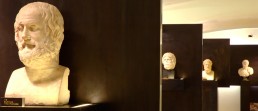
Marbles Museum
Florence, ITALY - 2006
Addressing the theme of an exhibition project inevitably means engaging with the ongoing debate on modes of display. The project concept emerges from the dialogue between the promoter’s various needs and expectations and the works themselves, in their specificity.
We sought to reconcile the objective of natural flexibility and adaptability of the exhibition system to different possible contexts with the intention of encouraging and supporting an emotional engagement with the visitor, while avoiding forced solutions or stylistic superimpositions aimed at easy visibility.
It therefore felt natural to adopt a language that is at once neutral in its relationship with the exhibited works, and yet possesses a strong, clear, and autonomous identity in relation to the context. We selected a material that belongs both to history and to modernity:
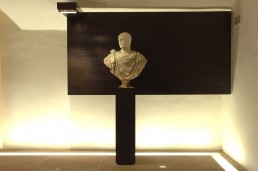
a burnished brass, monochrome yet not flat, used to shape simple but not predictable forms. These forms constitute, now and in future contexts, a distinct world dedicated to the “Marble Faces.”
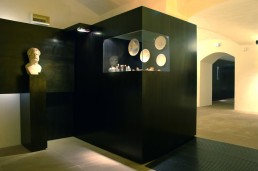
The use of various possible exhibition components (bases, panels, lighting) has given rise to an “exhibition element” that is not merely a new object, but an experience. The forms, techniques, and materials employed in the installation present themselves in apparent service to the exhibited objects and their understanding. Yet their properties, called upon to reveal and develop those of the objects on display, in fact define them and are, in turn, defined by them. Through this interaction, they form a meaningful structure—an experience of knowledge.
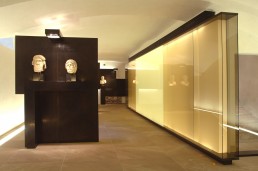
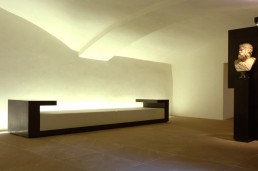
The use of accent lighting alongside diffused light preserves the softness of the modeling and prevents the expressiveness of the faces from being flattened. The possibility of transferring the exhibition to other spaces has led to a form of decontextualization of the display elements: the exhibition space becomes an almost neutral container, with covering draperies and transparent veils that both conceal and reveal.
The bases integrate the busts and heads without diminishing their singularity: they become their expressive extension in space, dissolving and disappearing within it. The backdrop panels compose the objects and arrange them within the space. The system incorporates a balanced lighting element, integrated with the design of the bases and backdrop panels.
Museo dei marmi
Palazzo Medici Riccardi
Via Cavour 3
50129 Firenze